Showing posts with label Hazardous Substances Sydney. Show all posts

Monday, 14 May 2018

Tips Related To Waste Collection Sydney and Effective Management

Companies engaged in waste collection Sydney often have way too much garbage and waste to deal with. Sometimes, it is much more than expected and in these situations, cleaning becomes very expensive and most importantly, time-consuming too. Therefore, we have come up with a post that would help these companies take proper care of the accumulated garbage and that too, without investing too much of time.

Examine the contents of your waste carefully
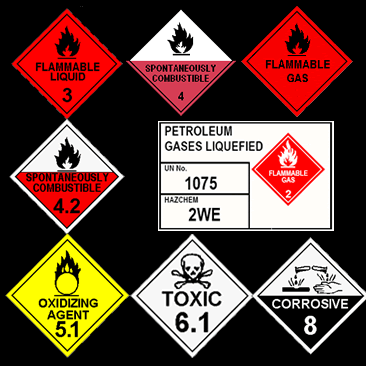
  • If you belong to this industry, you would be well aware that the first step in dealing with hazardous substances Sydney is having a deep look at the contents.
  • You should take note of any larger items, liquids and chemicals because each has to be disposed in a different manner.
  • This will also help you outline the staff as they come for waste collection Sydney.
Estimate your waste load
  • The next tip says that you need to take an estimate of the load of your waste and this is important because heavier items will cost more to dispose of than lighter items. 
  • If possible, make an estimate of the load or at least, the list of heavy items you have.
  • According to the experts, the same trick is to be applied in liquid waste disposal because the larger your load is, the more it may cost to dispose of.
Check your access routes to your waste
  • As far as transportation is concerned, experts say that before transferring them to the facility, it is important that you give a clear access to your garbage.
  • The reason is that they may have to manually transfer the waste to their trucks and in this situation; it is your duty to make sure that their path is absolutely clear.
Other very important tips to note are – 
  • Bundle or bag up as much of your waste as you can and put like and like materials together
  • Outline your availabilities for pickup
  • Make sure that you are prepared before the waste removalists come

Monday, 19 February 2018

Different Coagulants Used in The Process of Wastewater Treatment Sydney

There are several aspects of industrial wastewater treatment Sydney that common people like us could not understand because of the technicality involved in them. One such aspect is iron based coagulants that help materials in getting destabilised and come together to form clumps. The best part of these coagulants is that they are totally soluble in water and thus, can be used in different kinds of wastewater treatment Sydney application. There are several of them and each has its own pros and cons and some of them are discussed in this post.

Ferric Chloride (FeCl3)
Pros:
  • According to the experts dealing with hazardous substances Sydney, it can react with phosphates and/or alkalinity to form insoluble iron salts.
  • This coagulant is ideal for removing metals such as Cu, Ni, and Zn, solids, and phosphorous.
  • Moreover, it can also be combined with hydrogen peroxide to form Fenton's Reagent.
  • It is worth noting here that Fenton’s Reagent is used to oxidize organic contaminants in water.
Cons:
  • It is a highly corrosive compound.
  • It does stain on contact, so the water treatment equipment may take on a brownish color.
  • Moreover, it generates a large amount of sludge during chemical precipitation.
Liquid Waste Removal


Ferrous Chloride (FeCl2)
Pros:
  • According to experts of liquid waste removal, it is less corrosive than ferric chloride.
  • It can be used for a hexavalent chrome reduction, phosphorous removal and metals removal.
Cons:
  • The first con is that it leaves stains on contact.
  • It could also generate a large amount of sludge during chemical precipitation.

Ferric Sulphate (Fe2(SO4)3)
Pros:
  • Those engaged in wastewater treatment Sydney say that this coagulant is very effective in treating oily water, removing turbidity and phosphorus, and removing metals.
  • It can be very effective in terms of sludge dewatering.
Cons:
  • Just like those discussed above, this version too leaves stain on contact.

Tuesday, 19 December 2017

Liquid Waste Removal and Important Methods

Liquid waste is some form of liquid remains that can be dangerous to people or environment. It can be bulky or pure liquid. Restaurants, homes, cars, laundry or industrial building are the main source of these wastes. There the remains are found in septic tanks, wash-waters, solvents, photographic waste and laboratory etc. Chemical waste are the most important types of wastes. All these wastes can create big damage hence, liquid waste removal is very important.

If your company wants to keep environment safe and healthy for human being, they must consult to a liquid waste disposal professional. These services help companies to clean oily waters, septic tanks, liquid waste that can make water hazardous.

liquid waste removal

Methods of Liquid Waste Disposal

Some common methods to use for removing industrial liquid waste, which are:

Dewatering and Sedimentation: This modern technique is good for dealing with non-hazardous liquid waste as it has many advantages. Dewatering is the process in which the water is extracted so that only solid waste is left. In order to process this type of waste management, you need a permit from local agencies. These methods are used at construction sites as well.

Root Zone: This method is used to deal with liquid waste coming from kitchen or bath water. This water undergoes in multiple steps before it is released into the environment. This waste is first passed through a sedimentation tank then filtered using an innovative filtration technique. This method is best and quite simple though is being used critically.

Friday, 15 September 2017

What Is The Perfect Solution To Manage The Liquid Waste Disposal?

From a number of restaurants to almost all kind of companies collect a wide range of liquid waste disposal and look for the methods to manage this waste or storage efficiently. All liquid waste management require the Environmental Protection Agency approved the storage and transportation methods.  The liquid waste disposal management companies though safely transport and dispose of the large volume hazardous substances.

Why Liquid Waste Disposal Is Important

Collecting the liquid waste and hazardous substances at a safer place not only ensures that companies or industrial areas are contributing in environment cleaning rather people are also saving themselves from harmful diseases. 


If any business dealing with liquid waste disposal adopts a wrong method that can anyhow harm the environment can be issued with a legal notice. So, it is always suggested to keep less hazardous substances on the premises.

Choose A Safe Hazardous Substance Storage Area

The area should always be large enough and the waste inside the drum should be protected carefully when it is on the upper level of the drum. The area must not be located in the crowd. The position of the storage area is very important because in the case if it is surrounded by the stormwater drains then an accidental activity may pour the overall liquid waste disposal and give birth to danger.

Safe Area For Liquid Waste Storage

This area should be constructed and chosen very carefully as it is the prime source of any disease birth. The area should be clearly labelled and liquids in the storage should be perfectly stored. The bunds should be used in the cleaning operation as it help in leakage and all all. The design of the bunds should be simple so the hazardous substance inside the content can be pumped out.